
Pinecrest
A thoughtful guide to land, educational options, housing economics, and everyday life in Pinecrest.
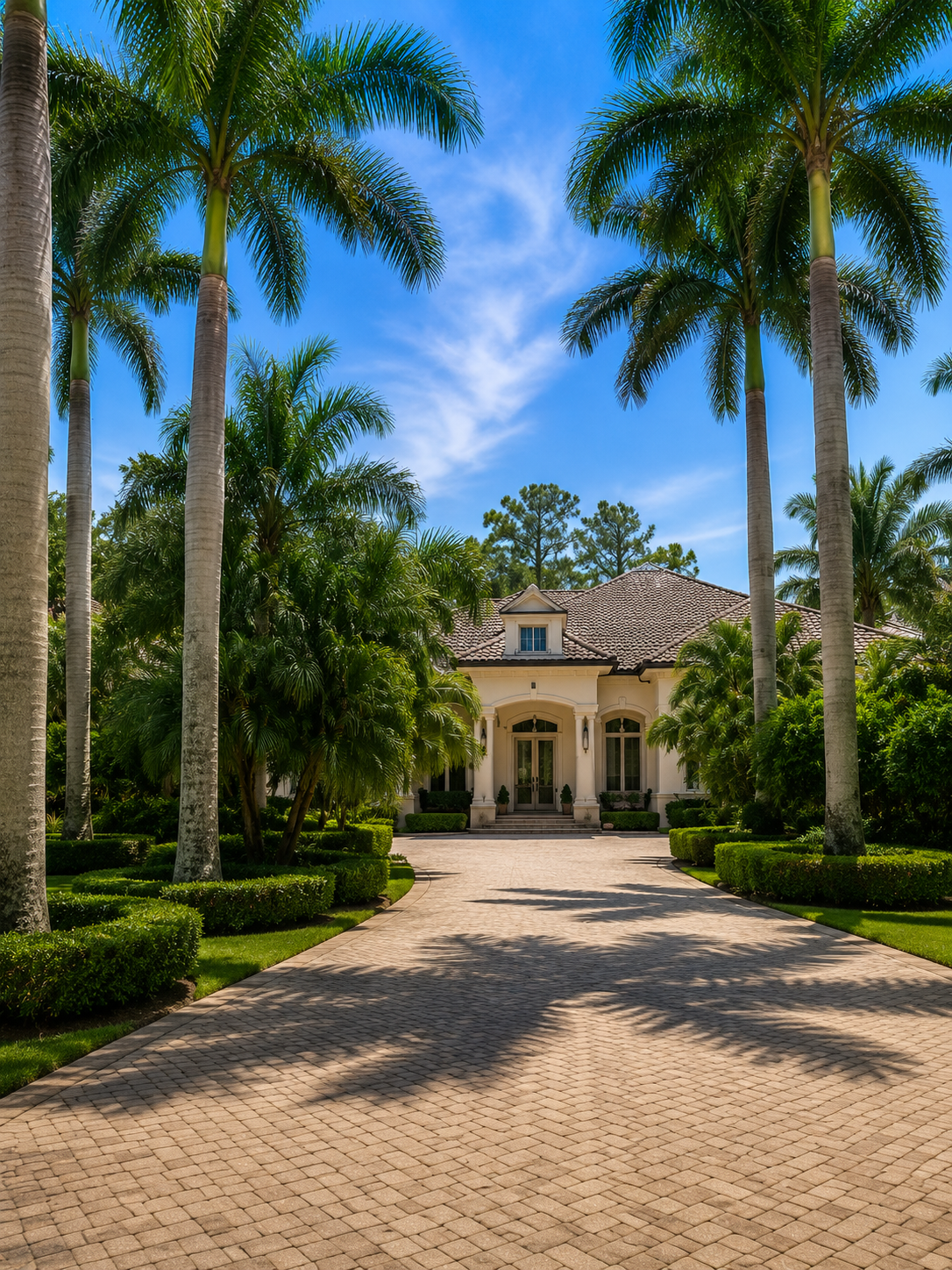
The Dr. Kate Perspective
For buyers seeking a long-term home in Miami, Pinecrest stands out for its highly regarded public schools, established private-school options, spacious residential lots, and quiet, low-density setting.
Its appeal reaches beyond large houses. Mature landscaping, private outdoor space, and established streets can provide a distinctive quality of everyday life.
There are trade-offs: most errands require driving, larger properties demand upkeep, and walkable retail and dining are less central to the experience than in Coconut Grove.
- Best For
- Long-term residents who prioritize educational choices, land, and privacy
- Core Value
- Schools · Land · Privacy · Residential Lifestyle
- Housing Focus
- Large-lot single-family homes · Renovations · New construction
- Biggest Trade-off
- Driving · Commuting · Property maintenance
- Main Risks
- Site constraints · Building systems · Drainage · Ownership costs
- Best Comparisons
- Coral Gables / Coconut Grove
Where Is Pinecrest, and Who Does It Suit?
Located in southern Miami-Dade County, the Village of Pinecrest was incorporated in 1996 and covers approximately eight square miles. Its boundaries generally run from Snapper Creek Canal to SW 136th Street, between Red Road and US 1.
Pinecrest is primarily an established single-family residential community, characterized by leafy streets and comparatively generous lots. Shopping and services are available along US 1 and in nearby Dadeland and South Miami, but the residential lifestyle remains largely car-oriented.
Who is a strong fit?
Buyers planning to settle into a four- or five-bedroom home with a dedicated office, pool, and meaningful outdoor space may find Pinecrest especially compelling. Those who work remotely, enjoy entertaining, or spend considerable time at home may realize tangible value from additional land.
Who may prefer another neighborhood?
Buyers commuting daily to Brickell or Downtown Miami should test travel times. Those who prioritize cafés and walkable streets may prefer portions of Coconut Grove or Coral Gables. Seasonal owners seeking minimal upkeep may be better served by a managed luxury condominium.
Pinecrest is appealing not because it fits everyone, but because it supports a distinctive set of residential priorities.
What Are You Really Buying in Pinecrest?
Structural Value: Land Comes First
Lot size, configuration, street location, mature landscaping, and future flexibility can matter as much as the house. Kitchens and bathrooms can be updated; the underlying parcel and its location cannot.
But a larger lot is not automatically a better lot. Setbacks, easements, protected trees, and drainage conditions may constrain what can actually be built or used.
Lifestyle Value: Will You Use the Space?
A backyard, home office, swimming pool, or outdoor kitchen creates real value when it serves your routine. Amenities that are rarely used may become recurring costs instead.
The right question is not how much space a property offers, but how well that space supports the life you intend to live.
Public and Private Schools
Educational choices are an important part of Pinecrest’s appeal. Buyers should consider both public-school assignments and independent-school options, while keeping educational suitability separate from any single ranking.
Public Schools
Schools associated with the Pinecrest area include Pinecrest Elementary, Palmetto Elementary, Howard Drive Elementary, Palmetto Middle, and Miami Palmetto Senior High.
School assignment must be confirmed for the specific property address through Miami-Dade County Public Schools. Programs, eligibility, and attendance boundaries may change.
Private Schools
Gulliver Preparatory School maintains its Upper School campus in Pinecrest, with its PK–8 Marian C. Krutulis Campus nearby in Coral Gables. St. Louis Catholic Covenant School is another option in Pinecrest.
Private-school admission is not tied to residency alone. Families should confirm grade levels, academic programs, tuition, transportation, and admission requirements directly with each school.
Beyond School
Pinecrest Gardens, Coral Pine Park, Evelyn Greer Park, and Suniland Park contribute to local recreation and community life.
Would you still enjoy this home if your child’s educational plans changed? The strongest long-term choice should work beyond any one school year.
Housing Types, Market History, and Value
Pinecrest includes older single-family houses, renovated homes, new-construction luxury properties, and potential teardown or redevelopment sites. The appropriate choice depends on the buyer’s desired timeline, willingness to renovate, and the economics of the land and existing improvements.
Four Property Categories
Older single-family homes may offer attractive established lots but warrant inspections of roofing, electrical, plumbing, air conditioning, drainage, and past alterations.
Renovated homes can offer convenience; attractive finishes do not establish that major building systems have been updated.
New construction may offer modern layouts, higher ceilings, and newer systems, but construction quality and market comparables remain essential.
Teardown and redevelopment properties require a full analysis of acquisition costs, building limitations, construction budgets, permitting, and eventual resale value.
Residential Price History | 2015–2024
University of Florida Shimberg Center / Florida Department of Revenue historical observations show the Pinecrest single-family annual median closed-sale price at approximately $1.05 million in 2015 and $2.80 million in 2024. Recorded volume was 429 transactions in 2021 and 179 in 2024.
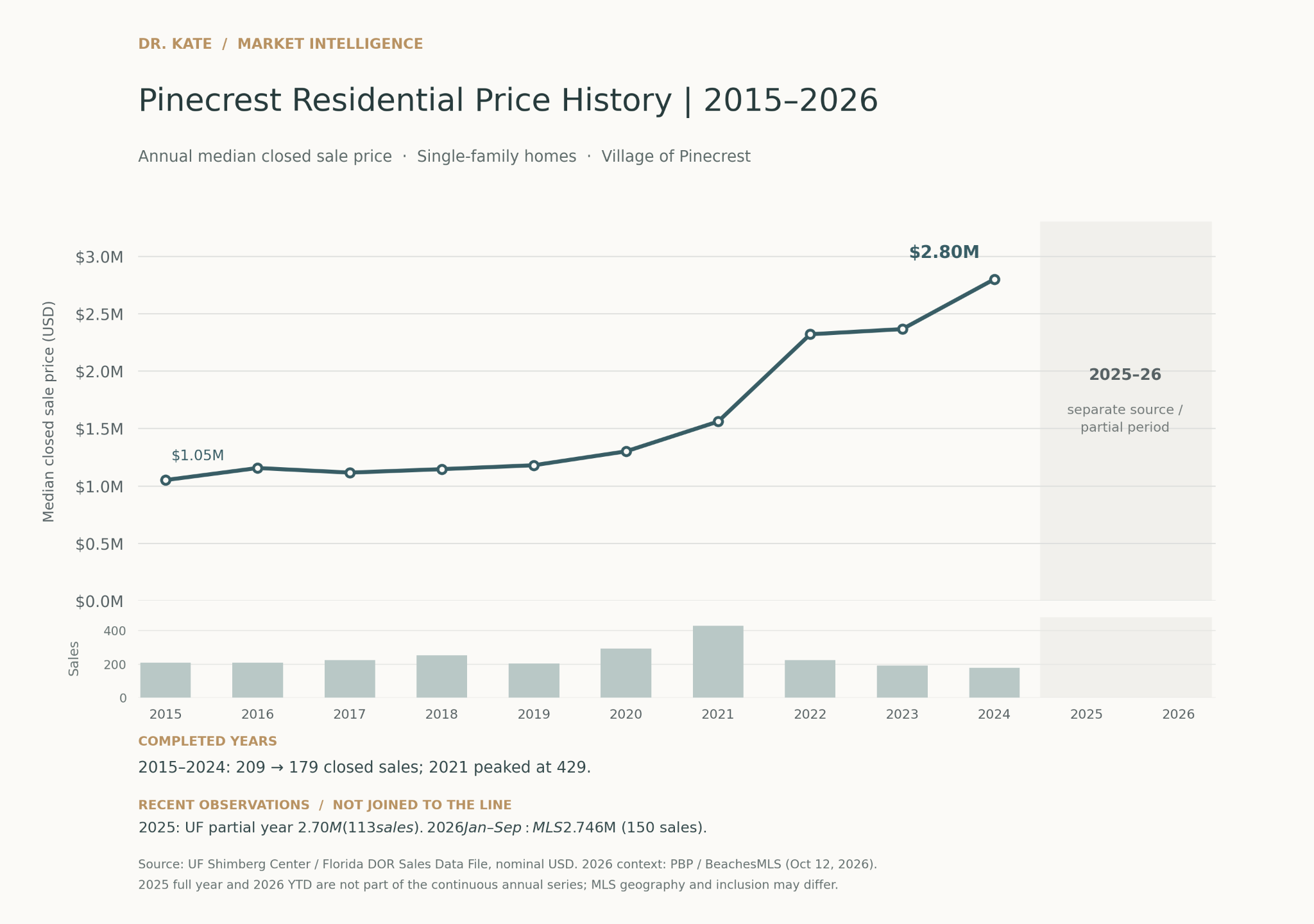
The chart retains the previously approved visual. For the formal historical series, 2015–2024 is the comparable full-year interval; any 2025–2026 observations should be treated separately and labeled by their own methodologies.
Annual medians describe the homes that happened to sell in a given year; they are not a repeat-sales appreciation index for an individual property. Property size, renovation status, and the mix of newly built houses can affect results.
Current Market Snapshot | September 2026
| Metric | Reported Value |
|---|---|
| Median sale price | Approximately $2.70M |
| Year-over-year change | +7.9% |
| Sale-to-list ratio | 95.5% |
| Median days on market | 71 |
Source: Redfin Pinecrest housing market, September 2026. The platform’s all-home-types and rolling-period measures are not directly comparable with the single-family annual historical series.
For a specific luxury home, land quality, condition, location, and truly comparable closed sales matter more than a neighborhood-wide median.
Two Sales, Two Different Value Propositions
Case A | 7821 SW 129th Terrace
Reported closing price: $2,250,000
| Closing date | September 25, 2026 |
|---|---|
| Living area | 3,585 sq. ft. |
| Lot size | Approximately 0.89 acre |
| Built | 1953 |
This older residence has a substantial lot and mature outdoor environment. Dr. Kate analysis: examine land quality, the condition and utility of the existing home, and the actual feasibility of renovation or redevelopment before assigning value to potential future use.
Case B | 12801 SW 61st Avenue
Reported closing price: $4,550,000
| Closing date | August 24, 2026 |
|---|---|
| Living area | 5,802 sq. ft. (reported) |
| Lot size | Approximately 0.82 acre |
| Built | 1991 |
Public listing information describes a single-story home with a pool, spa, tennis court, and extensive living amenities. Dr. Kate analysis: the higher price is associated with more existing residential improvements despite a slightly smaller lot, though condition, specific location, and other features prevent a simple dollar-for-dollar attribution.
Land matters. So does the value of what is already built on it.
Historical examples, not active listings or appraisals. MLS/county record confirmation and living-area definition are relevant when making property-specific decisions.
Choosing Within Pinecrest
For initial orientation, North, Central, and South Pinecrest can be useful geographic labels. They are not official pricing districts.
North Pinecrest may be advantageous for routines focused on South Miami, Coral Gables, or farther north. Central Pinecrest merits attention to interior streets, tree canopy, land configuration, and access. South Pinecrest can offer desirable residential lots, but regular northbound commuting should be tested.
Street traffic, noise, lot shape, setbacks, drainage, and mature vegetation can materially differentiate properties that look similar in a listing.
Micro-location often matters more than the broad neighborhood label.
Ownership Costs and Due Diligence
Property Taxes
The current owner’s tax bill may differ substantially from a new buyer’s future taxes. Estimate the new assessment and applicable exemptions rather than using the seller’s bill as a forecast.
Insurance and Building Systems
Get property-specific insurance quotes before purchasing. Roof condition, wind protection, building age, plumbing, electrical systems, and permitted renovations all matter.
Drainage and Water Risk
Even away from the ocean, a property may face drainage or water-intrusion concerns. Review FEMA mapping, parcel elevation, and practical site conditions separately.
Landscaping and Redevelopment
Large yards, pools, and mature trees bring ongoing expenses. Major expansion or rebuilding may require setbacks, easement, tree-protection, septic/sewer, and permitting analysis.
The relevant budget is not only what you can afford to buy, but what you are comfortable maintaining over time.
Pinecrest vs. Coral Gables vs. Coconut Grove
| Dimension | Pinecrest | Coral Gables | Coconut Grove |
|---|---|---|---|
| Defining appeal | Land, educational options, privacy | Architecture, established neighborhoods, city access | Walkable pockets, village culture, bay lifestyle |
| Housing | Large-lot single-family | Historic and luxury residences | Single-family, condos, waterfront |
| Walkability | Generally limited | Stronger in selected districts | Stronger near the village core |
| Primary trade-off | Driving and maintenance | Location-specific constraints | Lot size, density, pricing |
Pinecrest or Coral Gables?
Prioritize Pinecrest when private yard space, a pool, and a predominantly residential setting lead your decision. Explore Coral Gables when work, social life, and daily convenience point closer to its urban core.
Pinecrest or Coconut Grove?
Choose the Grove’s central areas for a more walkable, village-like experience. Consider Pinecrest when private outdoor space and a quieter residential rhythm are the higher priorities.
The best purchase is not necessarily the most square footage. It is the home that fits how you live.
Is Pinecrest Right for You?
Pinecrest is a compelling Miami-area choice for buyers who value established residential streets, land, privacy, and educational choices. But that does not make every Pinecrest property a sound purchase—or limited land supply a guarantee of appreciation.
Before recommending a home, I would focus on three questions: Is the land genuinely strong? Does the existing home support your day-to-day needs? And is the price justified by relevant sales and realistic ownership costs?
Better Real Estate Decisions Start with Better Questions.
Pinecrest Homebuying FAQ
Are Pinecrest public schools highly regarded?
The area includes several established schools. Actual assignment and program suitability must be verified for a specific address and student.
Which private schools are nearby?
Gulliver Preparatory School and St. Louis Catholic Covenant School are examples to research. Confirm admissions, grade levels, and campus locations directly.
Are older homes worth buying?
Some offer valuable land, but renovation costs, building condition, and redevelopment limitations determine whether a particular purchase makes sense.
Is Pinecrest better value than Coral Gables or Coconut Grove?
Not universally. Compare the actual homes, locations, costs, and the lifestyle each property supports.
Will land values always rise?
No. Entry price, market conditions, property characteristics, and future demand remain important.